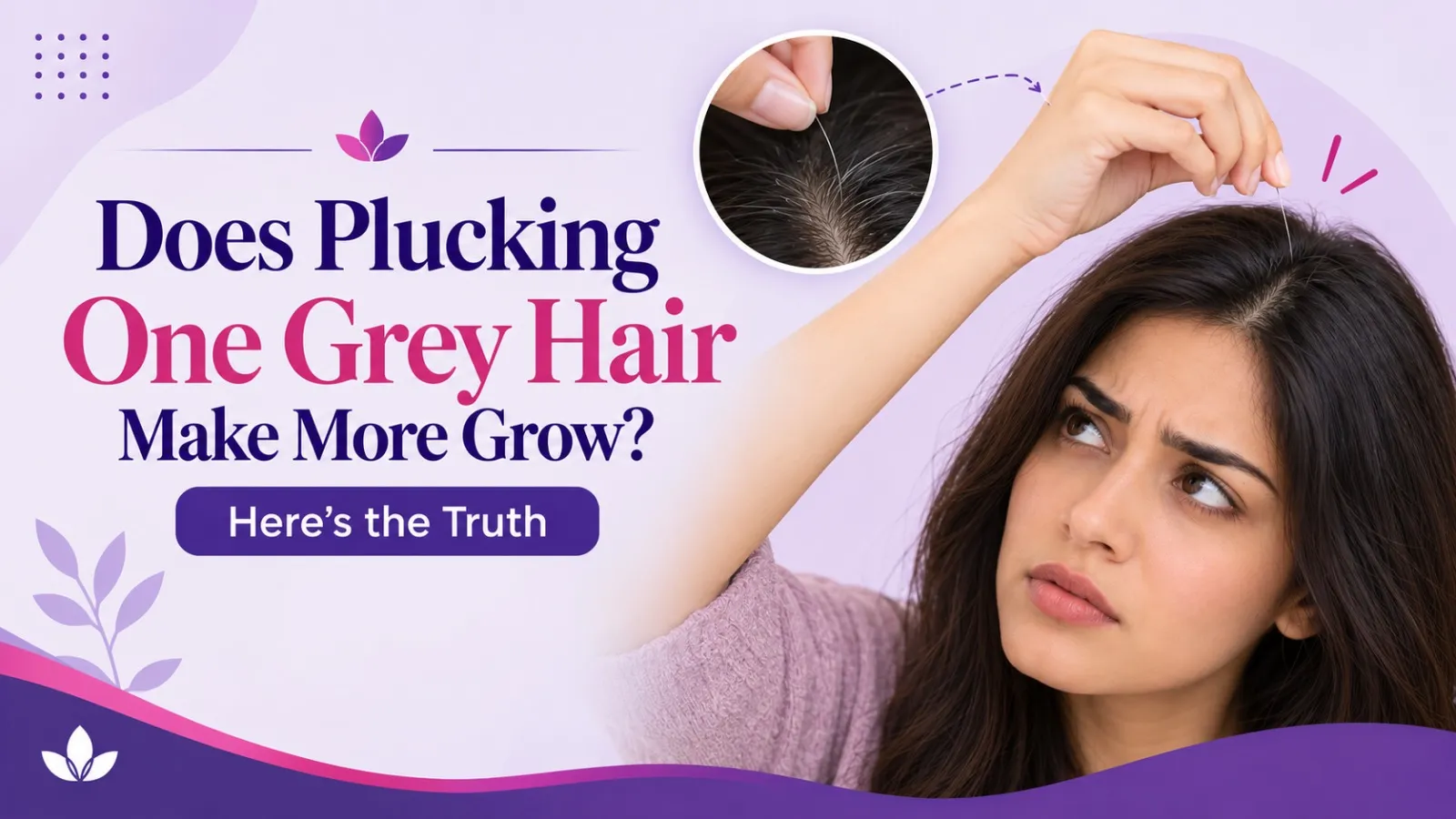
You spot a single grey hair while looking in the mirror. Your first instinct might be to pull it out before anyone notices. But then someone warns you, “Don’t pluck it! More white hairs will grow in its place.”
It’s a common belief that many people grow up hearing. But is there any truth to it?
The simple answer is no, plucking one grey hair does not make more grey hairs grow. However, repeatedly pulling out grey hair can damage the hair follicle over time. To understand why, it helps to know what makes hair lose its colour in the first place.
Why Does Hair Turn Grey?
Your hair gets its natural colour from a pigment called melanin. Special cells in the hair follicles produce this pigment, which gives your hair its colour.
As you age, these cells gradually become less active or stop producing enough melanin. As a result, new hair grows with less colour, eventually appearing grey or white.
Several factors can influence when this happens, including:
- Genetics: If your parents started greying early, you may notice grey hair at a similar age.
- Age: The natural ageing process gradually affects melanin production.
- Nutritional deficiencies: Low levels of certain nutrients, such as vitamin B12, can sometimes contribute to early greying.
- Certain health conditions: Some medical conditions may be associated with premature greying.
In many cases, grey hair is simply a natural part of ageing and does not indicate a health problem.
What Happens When You Pluck a Grey Hair?
Every hair grows from an individual follicle in your scalp. When you pluck a grey hair, you remove the hair strand from its follicle, but you do not remove the follicle itself.
The follicle can grow another hair, but the new strand will usually be grey or white because the pigment-producing cells in that follicle have not suddenly started working again.
Plucking one grey hair also does not affect the neighbouring follicles. Each follicle produces its own hair, so pulling out one strand cannot turn nearby hairs grey.
The real problem is repeated plucking. Pulling hair out again and again can irritate the scalp and damage the follicle. Over time, this may lead to inflammation, scarring or reduced hair growth in the affected area.
So, while plucking a grey hair will not create more grey hairs, it is still a habit worth avoiding.
Will the Grey Hair Grow Back Thicker or Whiter?
Another common concern is that a plucked grey hair will grow back thicker, coarser or even whiter than before.
This is not necessarily true. Plucking does not change the hair’s natural colour or thickness. A new strand may feel different because of its texture or the way it grows back, but pulling it out does not make the follicle produce a stronger or whiter hair.
Grey hair can sometimes feel coarser than pigmented hair because changes in the hair fibre and scalp can affect its texture. However, this is not caused by plucking.
Is It Better to Cut a Grey Hair Instead?
If a single grey strand bothers you, trimming it close to the scalp is a better option than pulling it out.
Cutting the hair does not damage the follicle, and it does not affect the colour of the hair growing underneath. You can also leave it alone, as removing one strand is not necessary for scalp health.
If you are noticing more grey hairs, it is important to remember that this is usually a gradual process. Removing individual strands will not change how quickly your hair turns grey.
What If You Are Getting Too Many Grey Hairs at a Young Age?
Finding a few grey hairs is generally not a reason to worry. However, if your hair starts turning grey much earlier than expected or the change happens unusually quickly, it may be worth discussing it with a dermatologist.
Genetics is often the main reason for early greying, but a doctor may consider factors such as nutritional deficiencies or other health conditions when appropriate.
There is no guaranteed treatment that can restore natural hair colour in every case. If an underlying deficiency is contributing to the problem, treating it may help in some situations, but existing grey hair does not always regain its colour.
For people who are concerned about the appearance of grey or white hair, hair colouring is one option for covering it. Treatments such as PRP (Platelet-Rich Plasma) and GFC (Growth Factor Concentrate) are used in certain hair-loss conditions, but they are not established treatments for reversing grey hair.
Key Takeaway
Plucking one grey hair will not make more grey hairs grow, and it will not stop the natural greying process either. The colour of each strand depends on the pigment produced by its own hair follicle, not on whether a nearby hair has been pulled out.
If you notice a grey strand, there is no need to panic or rush to remove it. Trim it if it bothers you or simply leave it alone. If you are experiencing unusually early or rapid greying, a dermatologist can help you understand whether there may be an underlying cause.
Frequently Asked Questions (FAQs)
- If I pluck one grey hair, will two grow back?
No. Plucking one grey hair does not cause two or more hairs to grow in its place. The same follicle may grow another grey hair, but neighbouring follicles are not affected.
- Will plucking grey hair make it grow back thicker?
No. Plucking does not make hair thicker or change its natural colour. A new strand may feel different, but this is not because it was plucked.
- Does cutting grey hair make it spread?
No. Cutting a grey hair has no effect on the colour of other strands or the hair growing from nearby follicles.
- Can grey hair turn black again naturally?
In some cases, hair colour may partially return, particularly if greying is linked to a reversible factor. However, age-related and genetic greying is not reliably reversible, and there is no guaranteed way to turn all grey hair black again.
- Can a dermatologist help with premature greying?
Yes. A dermatologist can assess early or unusually rapid greying and check whether further evaluation for nutritional deficiencies or other possible causes is appropriate. Treatment depends on the cause, and not every case requires medical treatment.
- Do hair treatments like PRP or GFC reverse grey hair?
PRP and GFC are used for certain hair-loss concerns, but there is currently insufficient evidence to establish them as effective treatments for reversing grey hair. They should not be considered a proven solution for restoring natural hair colour.